

Texting has its own language. Short forms like LOL, BTW, and IDK are easy to guess. But some abbreviations are trickier, and NTP is one of them. If a friend sent you “NTP” and you had no idea what it meant, you are not alone.
This guide breaks down the full NTP meaning in text, where it comes from, how people actually use it in real conversations, and when you should avoid it. By the end, you will never be confused by this text abbreviation again.
Slang like this pops up everywhere, especially in fast-moving group chats where people care more about speed than spelling things out. New abbreviations show up so often that even active texters miss a few along the way. That’s exactly why this guide exists: to walk you through the real meaning, the tone behind it, and the small details that change how it should be read.
NTP Meaning in Text (Quick Answer)
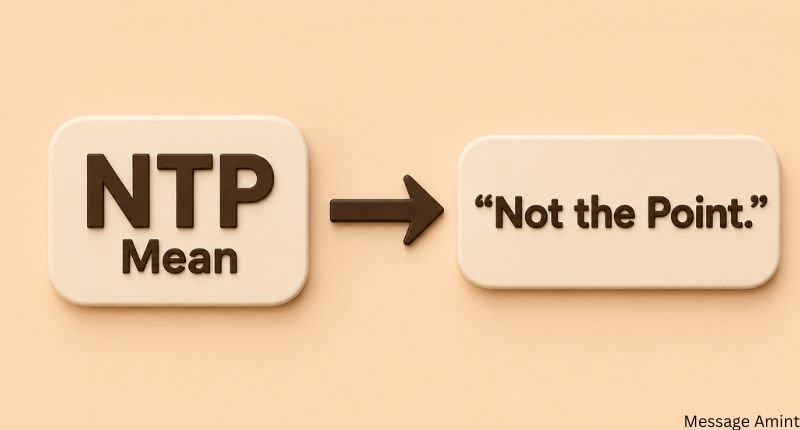
NTP means “Not the Point.” People use it in casual texting and online chats to say that something in the conversation is not actually relevant to the main issue being discussed. It is a quick way to redirect a chat back to what really matters.
For example:
A: “I was stuck in traffic.” B: “NTP. You still didn’t tell me you’d be late.”
Here, B is not denying the traffic. B is simply saying that traffic is not the main problem. The real issue is that A did not send a warning message.
This short reply carries a lot of meaning in just three letters. It skips the small talk and gets straight to what actually matters in the conversation. That’s the whole appeal of NTP: it lets people stay focused without typing a long explanation every time someone drifts off topic.
What Does NTP Mean in Text?
The NTP meaning in text is simple once you understand its purpose. It stands for “Not the Point,” and people use it when someone brings up something that does not address the actual topic.
Think of it as a gentle (or sometimes blunt) way of saying, “That’s a fair comment, but it doesn’t answer my question.” It works well in casual chats, group messages, and social media comments, especially when a conversation starts to drift away from the main issue.
This texting abbreviation is common among younger users, particularly in group chats where conversations can move quickly and go off track. Instead of typing a full sentence, “NTP” saves time while still making the point clear.
It is worth noting that tone matters a lot here. The same three letters can sound playful between close friends, or sharp and dismissive between strangers. Context and relationship always shape how it lands.
What makes NTP different from many other chat abbreviations is that it doesn’t just save typing time, it also carries a specific social function. Words like LOL or BRB simply describe an action or reaction. NTP, on the other hand, is used to challenge or redirect what someone else just said. That small difference is why it can feel more pointed than a typical piece of internet slang, and why understanding the full NTP meaning in text matters before you use it yourself.
Because of this redirecting function, NTP tends to show up more in conversations that already have some tension or disagreement, rather than in neutral small talk. Knowing this pattern can help you recognize the abbreviation faster the next time it appears on your screen.
Read Also: TSK Meaning in Text
What Does NTP Stand For in Texting?
In almost every casual conversation, NTP stands for “Not the Point.” It is used as a short, direct reply when someone feels the conversation has strayed from what actually matters.
People often use it right after someone gives an explanation, excuse, or unrelated comment. Instead of writing out the full phrase, they simply type “NTP” and let the other person figure out the meaning from context.
This abbreviation belongs to a wider group of chat abbreviations built to keep conversations fast and efficient. Just like NP means “No Problem” and NVM means “Never Mind,” NTP fits into that same category of short, functional slang.
NTP in a Simple Sentence
Here are a few simple examples of how NTP fits naturally into a sentence:
- “NTP, we’re talking about what happened today.”
- “That’s NTP right now, let’s focus on the actual issue.”
- “I get it, but NTP.”
Each version carries the same underlying message: the current comment is not addressing the real topic.
Where Did NTP Come From? (Origin & History)
Unlike older internet slang such as LOL or BRB, which trace back to early chatrooms and forums, NTP is a more recent addition to casual digital language. It grew naturally out of everyday texting culture rather than from any single platform or trend.
The phrase “not the point” has always existed in spoken English as a way to interrupt a tangent. As texting became the dominant form of daily communication, people naturally started shortening common phrases to save time and effort. NTP followed the same pattern as other abbreviations like NVM (never mind) and IMO (in my opinion).
It became more visible in group chats and comment sections, where fast-paced back-and-forth conversations benefit from short replies. Because it is not tied to a specific app or community, NTP spread gradually through everyday texting rather than going viral overnight. Today, it sits in that middle category of slang: widely understood by frequent texters, but not yet as universal as LOL or OMG.
Where Is NTP Commonly Used?
NTP shows up most often in real-time, casual conversations where people type quickly and expect the other person to understand shorthand. It is less common in formal writing and more common in fast digital exchanges.
Common platforms:
- WhatsApp – common in personal chats and group conversations
- Instagram DMs and comments – used when replying to a comment that misses the point
- Discord – frequent in gaming and community servers during fast discussions
- Twitter/X – used in reply threads to redirect a debate
- Snapchat – appears in quick back-and-forth chats between friends
- Text messages (SMS/iMessage) – common between friends and family in casual talk
On Discord and gaming platforms specifically, NTP often appears during strategy discussions or post-match reviews, where players want to quickly separate excuses from the actual mistake that cost the game. On Twitter/X, it frequently shows up in reply threads under a debate, where someone tries to steer the discussion back to the original claim instead of letting it drift into unrelated arguments.
Tone:
The tone of NTP can shift depending on who is using it. Among close friends, it often feels light and quick, almost like a verbal shrug. In a heated argument or a debate with a stranger, the same word can feel blunt or even confrontational. Reading the tone of the overall conversation is the best way to judge how someone means it.
Punctuation and extra words can soften or sharpen the message too. “NTP.” with a period can read as final and abrupt, while “ntp lol” or “kinda ntp tho” feels much more casual and friendly. Paying attention to these small details helps you judge the sender’s intent more accurately.
Read This: LBS Meaning in Text
Examples of NTP in Conversation
Seeing NTP in different situations makes the meaning much clearer. Below are a few real-world style examples.
Example 1: Friends
A: “Why didn’t you tell me about the party?” B: “I thought you were busy.” A: “NTP. You could’ve still told me.”
Here, A is not disputing that B thought they were busy. A is pointing out that this excuse does not solve the real issue, which is that B never mentioned the party at all.
Example 2: Online Chat
A: “The game was really hard.” B: “NTP, you still didn’t complete the challenge.”
B acknowledges the game was difficult but redirects the conversation back to the unfinished challenge, which was the actual topic.
Example 3: Casual Argument
A: “But everyone else was doing it.” B: “NTP. We’re talking about what you did.”
This is a classic case of NTP shutting down a common excuse. B is not interested in what other people did; the focus stays on A’s specific action.
Example 4: WhatsApp / Instagram DM
A: “Sorry I missed your call, I was in a meeting all day.” B: “NTP, you saw my message three hours ago and didn’t reply 👀”
This example shows how NTP plays out in real messaging apps, where read receipts and timestamps often become part of the argument itself.
Here are a few more quick, everyday snapshots of NTP in action, the way it actually shows up in real chats:
1️⃣ A: “I forgot my charger, that’s why I didn’t text back 🙃” B: “ntp, you were near an outlet the whole time 👀”
2️⃣ A: “I was multitasking so I missed what you said.” B: “ntp, just focus for a sec 😅”
3️⃣ A: “My phone was on silent.” B: “ntp, you replied to everyone else though”
Notice how each reply stays short and casual, often paired with lowercase letters or a light emoji. That combination is what keeps NTP feeling more like a nudge between friends than a harsh accusation.
Example 5: Family Group Chat
Mom: “Why is the kitchen still messy?” A: “I was doing homework all evening.” Mom: “NTP, I asked you to clean it before dinner.”
Even in family conversations, NTP can appear when someone wants to keep the focus on a specific request rather than accept a general excuse. This shows that the abbreviation isn’t limited to friend groups; it can pop up in almost any relaxed, everyday conversation.
Is NTP Rude?
This depends entirely on the relationship and the tone of the conversation. Sending just the word “NTP” with nothing else can feel abrupt, since it tells the other person their comment is irrelevant without any softening.
Between close friends, it usually comes across as playful or matter-of-fact. In a serious discussion, a debate with a stranger, or a professional setting, it can sound dismissive or even confrontational.
If you want to make the same point without sounding harsh, try one of these NTP alternatives:
- “That’s not really the point.”
- “I get that, but that’s not what I mean.”
- “True, but that’s not the issue.”
- “I understand, but my point is…”
Softer phrasing keeps the conversation constructive while still redirecting it back to the main topic.
Another thing to consider is timing. Sending NTP right after someone shares something personal or emotional can feel dismissive of their feelings, even if that isn’t the intention. Waiting a beat, or pairing it with a bit of context, usually keeps the conversation friendly instead of cutting the other person off completely.
Explore More; IGH Meaning in Text
When to Use and When Not to Use NTP
Knowing when NTP fits naturally into a conversation, and when it does not, helps you avoid unnecessary friction.
✅ When To Use NTP:
- In casual chats with close friends or family
- In group chats where the tone is already relaxed
- When a conversation genuinely drifts off track and needs a quick nudge back
- In gaming or community chats where short replies are the norm
- When replying to a comment that clearly avoids the real question
❌ When Not To Use NTP:
- In professional or work-related conversations
- When talking to someone you don’t know well
- During a sensitive or emotional discussion
- In customer service or formal customer chats
- When the other person may not know what the abbreviation means
Using good judgment about your audience is the safest way to avoid coming across as rude.
A simple rule of thumb: if you would feel comfortable saying “that’s not the point” out loud to that person, then texting “NTP” is probably fine too. If saying it out loud would feel awkward or harsh, it’s better to choose a full sentence instead.
How Do You Respond to NTP in Text?
If someone sends you “NTP,” the best response is usually a calm, clear explanation of your actual point rather than another abbreviation.
For example:
Them: “NTP, that’s not what we’re discussing.” You: “Okay, I see what you mean. My point was that it affected what happened afterward.”
Or, if you realize you misread the conversation:
“Oh, I see what you mean now.”
A short, clear reply usually works better than firing back with more slang. It keeps the conversation moving forward instead of turning into a back-and-forth over wording.
Quick Comparison Table
| Term | Meaning | Example Use |
| NTP | Not the Point | “NTP, we’re talking about today.” |
| NP | No Problem | “Thanks!” “NP!” |
| NVM | Never Mind | “NVM, I figured it out.” |
| NT | Nice Try / No Thanks (context-dependent) | “NT, that excuse won’t work.” |
| BTW | By the Way | “BTW, are you free tonight?” |
| IDK | I Don’t Know | “IDK what happened.” |
| IMO | In My Opinion | “IMO, that’s not fair.” |
This table shows how NTP fits alongside other common texting abbreviations, while keeping its own distinct meaning.
Notice that some of these abbreviations, like NP and NVM, tend to close a conversation on a friendly note, while NTP usually keeps the conversation going by pushing back on something. That single difference explains why NTP can feel more direct than most of the other short forms in this table.
Here’s a second way to look at the same idea, based on the context where each phrase actually works best:
| Context | Example Phrase | Why It Works |
| Friend chat | “NTP, that’s not what I asked 😅” | Casual and quick between people who know each other |
| Group chat | “NTP, let’s focus on the plan” | Keeps a fast-moving conversation on track |
| Debate/argument | “NTP. We’re talking about what you did.” | Clearly separates the excuse from the real issue |
| Work chat | “That’s a separate issue, let’s stick to the timeline.” | Sounds professional instead of blunt |
| Stranger online | “That’s not really the point here.” | Avoids sounding rude to someone you don’t know |
This second table makes it easier to see exactly when the short slang version fits, and when a full sentence is the smarter choice.
Similar Slang Words or Alternatives
If NTP feels too blunt for a certain conversation, several NTP alternatives carry a similar meaning with a softer tone:
- “That’s beside the point.”
- “That’s a separate issue.”
- “Let’s stay on topic.”
- “That doesn’t really answer my question.”
- “Not exactly what I meant.”
These phrases work well in situations where you want to redirect the conversation without sounding sharp, especially with people you don’t know very well.
You can also pair an alternative phrase with a bit of explanation to make your point land more gently. For example, instead of just saying “that’s not the point,” you could add a follow-up like “what I’m really asking is…” This keeps the conversation moving forward instead of making the other person feel shut down.
Other Meanings of NTP
Outside of casual texting, NTP has an entirely different meaning in technology. In networking and IT, NTP stands for Network Time Protocol, a system used by computers and servers to keep their internal clocks synchronized across a network.
For example:
“The server isn’t syncing with the NTP server.”
In this sentence, NTP clearly refers to the technical protocol, not the slang term. Anyone working in networking, cybersecurity, or system administration will likely recognize this meaning first.
Context is the easiest way to tell the two apart. If the conversation involves servers, clocks, or networks, it almost certainly refers to Network Time Protocol. If it involves a disagreement, excuse, or redirected argument, it almost certainly means “Not the Point.”
Network Time Protocol has been around since the 1980s and is one of the oldest protocols still actively used on the internet today. It plays a quiet but important role behind the scenes, keeping systems like banking servers, security logs, and cloud platforms accurate to the second. IT professionals, network administrators, and anyone working in cybersecurity are far more likely to use NTP in this technical sense than in the slang sense.
So if a coworker in IT says “we need to fix the NTP settings,” they are almost certainly talking about clock synchronization, not a texting disagreement. Keeping both meanings in mind helps you avoid any mix-ups, especially in mixed personal and professional conversations.
See Also: What Does LMS Mean Texting
How Do You Say or Pronounce NTP?
Since NTP is an abbreviation, it is usually spoken as three separate letters: “en-tee-pee.” People rarely try to pronounce it as a single word. In spoken conversation, most people simply say “not the point” instead of using the abbreviation out loud, since NTP is designed mainly for typing, not speaking.
FAQs
1. What does NTP mean in texting?
The NTP meaning in the text is “Not the Point.” People use it to say that a comment or explanation does not address the main issue being discussed.
2. What does NTP mean on social media?
On social media, NTP usually means “Not the Point” as well. It often appears in comment sections or reply threads when someone responds with something unrelated to the original topic.
3. What does NTP mean on Instagram?
On Instagram, NTP is commonly used in DMs and comments with the same slang meaning, “Not the Point.” It helps redirect a conversation back to the original topic, especially in fast-moving comment threads.
4. Is NTP a common texting abbreviation?
NTP is understood by many regular texters, but it is not as widely used as abbreviations like LOL, OMG, or BTW. It tends to appear more in arguments, debates, or fast-paced group chats.
5. Can NTP mean something other than “Not the Point”?
Yes. In technology and networking, NTP commonly stands for Network Time Protocol, a system that synchronizes clocks across computer networks. The surrounding conversation usually makes the intended meaning clear.
6. What is an NTP in business?
In a business or IT context, NTP almost always refers to Network Time Protocol, since accurate time synchronization is important for servers, logging systems, and secure transactions. It rarely refers to the slang meaning in professional settings.
7. Is NTP rude or polite?
It depends on tone and relationship. Between friends, it can feel casual and quick. In a formal or unfamiliar conversation, it can come across as blunt or dismissive, so it’s worth reading the room first.
8. Is NTP the same as NP?
No. NTP means “Not the Point,” while NP means “No Problem.” They look similar but have completely different meanings, so mixing them up can cause confusion in a chat.
9. Should I use uppercase or lowercase (NTP vs ntp)?
Both are acceptable in casual texting. Lowercase “ntp” feels more relaxed and informal, while uppercase “NTP” is slightly more common and easier to read at a glance. Neither changes the meaning.
10. Can NTP be used in professional chats?
It’s best to avoid NTP in professional or work-related messages. Since not everyone recognizes the abbreviation, and it can come across as curt, a full sentence like “That’s a separate issue” is a safer choice at work.
Final Words
In most casual conversations, the NTP meaning in text is simple: “Not the Point.” It works as a quick way to steer a conversation back to what really matters, especially when someone’s response or excuse doesn’t address the actual issue.
That said, NTP is not one-size-fits-all. Its tone can shift depending on who you’re talking to, and it carries a completely different meaning in networking, where it stands for Network Time Protocol. Reading the context of the conversation is always the best way to understand which meaning applies.
Now that you know the full picture, from casual chats to technical networking, you’ll never be confused the next time someone sends you “NTP” in a text.
Slang like this makes texting faster and more natural once you know what it means. It’s one of those small shortcuts that keeps a conversation moving without needing a full sentence every time. Keep this guide in mind, and the next “NTP” that lands in your inbox will make perfect sense right away.

Iqra Mubeen is the Founder of Message Amint, with 3+ years of experience in SEO, content writing, and guest posting. She specializes in creating engaging, easy-to-share content around everyday communication — from heartfelt messages to relationship wishes. Her work focuses on helping readers express their feelings in the simplest, most meaningful way.