
TMI meaning in text confuses a lot of people the first time they see it — because the tone can feel funny, awkward, or even a little rude, depending on who’s saying it. You’re texting a friend, they suddenly share way more detail than you expected, and you type back: “TMI.” But what exactly does it mean, and why has it become one of the most used slang terms online?
This guide breaks down the complete TMI meaning in text, real conversation examples, when to use it (and when not to), plus everything else you need to use this word with total confidence.
Quick Answer: What Does TMI Stand For?
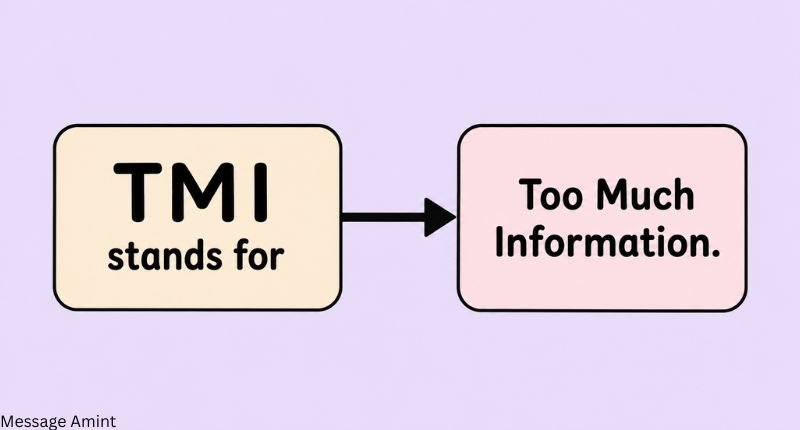
TMI stands for “Too Much Information.”
It’s used when someone shares details that are unnecessary, overly personal, or uncomfortable for the situation or context.
Key facts about TMI:
- It’s an internet slang abbreviation, not a formal word
- Mostly used in casual and humorous conversations
- Expresses mild discomfort or playful embarrassment
- Almost never meant to be offensive
Quick examples:
- “Okay, TMI 😅”
- “Bro, that’s TMI”
- “TMI, I didn’t need to know that!”
The tone and context decide whether TMI sounds funny, awkward, or slightly blunt — the phrase itself is neutral.
How to Pronounce and Say TMI
Wondering how to actually say it out loud? TMI is pronounced by saying each letter separately — “T-M-I” (tee-em-eye) — not as one single word. Understanding the correct TMI meaning in text also helps you use it the right way in speech, not just while chatting. Whether you’re texting online or talking face-to-face, it works the same way: a quick, one-word reaction to oversharing.
Origin and Background of TMI Meaning in Text
The full phrase “too much information” existed in spoken English long before texting existed. People used it during awkward conversations decades ago.
The abbreviation TMI became popular with the rise of:
- Online forums and early chat rooms
- Early social media platforms like Facebook and Twitter
- Meme culture and reaction-based comments
As digital communication got faster, people needed shorter reaction words. TMI became the go-to phrase to politely stop oversharing or redirect a conversation.
Social media has also shaped its tone. On platforms like Instagram and TikTok, TMI is almost always used humorously, especially in comment sections reacting to oversharing posts — rather than as a serious complaint.
Read Also: Whats Onb Mean?
Real-Life Conversations Using TMI
Seeing TMI meaning in text used in actual conversations makes everything much clearer than just reading a definition. Here are some real chat examples that show exactly how people use it in everyday texting.
WhatsApp Conversation
Person A: I didn’t sleep all night because I kept thinking about my ex and crying Person B: TMI bro… I asked how your exam went 😭
Instagram DM
Person A: Guess what? I just tracked my entire digestive system after that burger Person B: STOP… TMI 😭 I was eating while reading this
TikTok Comments
Person A: I wash my hair only once every 12 days Person B: TMI but also… why did I read this 💀
Text Message
Person A: I accidentally left the bathroom door open while singing loudly Person B: TMI 😭 but thanks for the mental image I didn’t need
These examples prove one thing clearly: TMI is almost always playful, not aggressive.
10 Ready-to-Use TMI Example Sentences
Want to use TMI meaning in text naturally in your own chats? Copy these ready-made examples and paste them wherever they fit.
- “Okay that’s TMI, but go on 😂”
- “TMI alert — skip this if you’re eating”
- “That’s a bit TMI for a Monday morning”
- “Full TMI, but I needed to tell someone”
- “TMI moment right there”
- “Major TMI, why would you tell me that”
- “TMI but also… relatable”
- “Okay TMI, changing the subject now”
- “That was so TMI I can’t unhear it”
- “TMI 💀 I did not need that visual”
The Emotional and Psychological Meaning Behind TMI
TMI is more than internet slang — it reflects how people set emotional boundaries in digital conversations.
When someone says “TMI,” they are usually:
- Reacting to discomfort in a light way
- Trying to reset the conversation
- Expressing playful embarrassment
- Signaling that a detail crossed a comfort boundary
Psychologically, TMI works like a social filter. It lets people stay honest about their comfort level while keeping the conversation friendly.
For example, if a friend shares an overly personal health detail during a casual chat, saying “TMI” gently communicates the real TMI meaning in text behind the word: “I care about you, but that detail is a bit much for this moment.”
It helps maintain the balance between openness and privacy — something every online conversation needs.
Read More: FG Meaning in Text
TMI vs Oversharing: What’s the Difference?
People often confuse these two terms, but they aren’t identical.
| Term | What It Means |
| TMI | A reaction someone gives when they feel information was excessive |
| Oversharing | The act of giving too many personal details in the first place |
In short: oversharing is the action, TMI is the response to that action.
Usage of TMI in Different Contexts
On Social Media On platforms like TikTok, Instagram, and X (Twitter):
- Used as a humorous reaction
- Common in comment sections
- Frequently paired with emojis like 😭💀
Among Friends and in Relationships
- Very common between close friends
- Used playfully, almost never seriously
- Often signals light teasing
At Work or in Professional Settings
- Rarely appropriate
- Can sound unprofessional if used directly
- Better replaced with phrases like “That’s quite detailed” or “Let’s keep that for later”
Casual Tone vs Serious Tone
- Casual: funny, light, meme-like
- Serious: can sound dismissive if misused
As with most slang, context decides everything.
When You Should NOT Use TMI
Once you understand the TMI meaning in text, it’s important to know when not to use it. Avoid saying TMI when someone is:
- Sharing emotional trauma
- Discussing health issues seriously
- Talking about personal struggles
Across Cultures In some cultures, a direct reaction like TMI can feel rude or dismissive, even when it’s meant casually.
In Formal Environments Never use TMI in:
- Job interviews
- Office emails
- Academic discussions
Common Misunderstandings About TMI
1. Thinking it’s always rude It isn’t. Tone matters more than the word itself.
2. Taking it too seriously In most online spaces, TMI is meant to be playful, not offensive.
3. Using it in the wrong moment Using TMI during serious emotional sharing can come across as insensitive.
4. Literal confusion Some beginners assume TMI is a technical term. It simply means oversharing.
TMI Meaning Comparison Table
| Expression | Meaning | Tone | Common Usage |
| TMI | Too Much Information | Casual / playful | Reacting to oversharing |
| Oversharing | Giving too many personal details | Neutral | General description |
| FYI | For Your Information | Neutral | Informative context |
| OMG | Oh My God | Emotional | Surprise or shock |
| SMH | Shaking My Head | Mild disapproval | Reacting to behavior |
Key insight: TMI is unique because it directly reacts to comfort level in a conversation — not just emotion or general information, like most other slang terms do.
Synonyms and Alternatives to TMI
If you want to express the same TMI meaning in text without actually saying “TMI,” try these alternatives instead.
- “That’s more than I needed to know”
- “Way too much detail”
- “Didn’t need that image in my head”
- “Overshare alert”
- “Spare me the details”
These work well as polite alternatives in slightly more formal casual settings.
Variations and Types of TMI
- “That’s TMI” — direct reaction to oversharing
- “TMI bro” — casual, friendly version
- “Okay TMI” — soft way of stopping details
- “TMI 😭” — humorous social media use
- “That’s a bit TMI” — polite version
- “Full TMI” — emphasizes extreme oversharing
- “TMI alert” — used jokingly before/after shocking details
- “Major TMI” — a stronger reaction to something uncomfortable
- “Too much info” — the full form, slightly more formal
- “TMI moment” — used when someone accidentally overshares
How to Respond When Someone Says TMI to You
Casual replies
- “Oops, my bad 😅”
- “Haha okay I’ll stop”
- “Didn’t mean to overshare”
Funny replies
- “TMI is my middle name”
- “Welcome to my oversharing era”
- “You asked for it 😂”
Mature replies
- “Got it, I’ll keep it short”
- “Understood, changing topic”
Respectful replies
- “Sorry, I didn’t realize it was too much”
- “Thanks for letting me know”
Regional and Cultural Usage of TMI
Western Culture Extremely common in memes and casual texting, generally used without any offense.
Asian Culture Increasingly popular among Gen Z, though still less common in formal conversation.
Middle Eastern Culture Mostly used by younger internet users, largely influenced by English social media trends.
Global Internet Usage TMI is now a universally recognized slang term with a strong presence across meme culture worldwide.
Generational Differences
- Gen Z: frequent, humorous use
- Millennials: more selective, situational use
- Older generations: may find it unclear or slightly rude
Explore More: NTP Meaning in Text
Is TMI Safe for Kids and Teens to Use?
Yes — TMI is generally safe for kids and teenagers since it isn’t offensive or abusive language.
That said:
- It should be understood in context
- Parents may want to explain tone sensitivity
- It’s actually a good, low-stakes way to teach kids about digital communication boundaries
Used properly, it’s a harmless piece of internet slang.
FAQs
What does TMI mean in chat?
TMI means “Too Much Information” — used when someone shares unnecessary or overly personal details.
Is TMI rude?
Not usually. It depends entirely on tone — in most cases, it’s playful rather than harsh.
When should I use TMI?
Use it when someone casually overshares in an informal conversation, like with friends or on social media.
Can TMI be used professionally?
No — it’s best avoided in formal or workplace communication. Use a more polite alternative instead.
What is the opposite of TMI?
Phrases like “FYI” or “brief info” are considered the closest opposites, since they signal just enough information.
Why do people say TMI?
To react to oversharing and maintain comfort in a conversation, without needing a long explanation.
Is TMI only used in English?
No — while it originated in English internet culture, it’s now used globally, including by non-native English speakers on social media.
Conclusion
TMI is a small phrase with a big role in modern digital communication. It helps people set boundaries, react honestly, and keep conversations comfortable — all without needing a long explanation.
Used correctly, it adds humor and clarity to everyday chats. Used carelessly, especially during a sensitive moment, it can come across as dismissive — so context always matters.
Now that you understand the complete TMI meaning in text, you can use it confidently and know exactly when (and when not) to say it in your own conversations.

Iqra Mubeen is the Founder of Message Amint, with 3+ years of experience in SEO, content writing, and guest posting. She specializes in creating engaging, easy-to-share content around everyday communication — from heartfelt messages to relationship wishes. Her work focuses on helping readers express their feelings in the simplest, most meaningful way.