
You’re scrolling through a comment section, or maybe your friend just texted you out of nowhere, and there it is: onb. No warning, no explanation, just three letters sitting in the middle of a sentence like you’re supposed to already know.
Most people don’t. And that’s fine, because slang like this spreads faster than anyone can keep track of. If you’ve typed “whats onb mean” into Google tonight, this guide gives you the full picture in one place — the real meaning, where it came from, and every version you might run into.
Onb is part of a bigger shift in how people write to each other. Modern texting slang moves fast, and digital communication slang like this spreads through group chats long before any dictionary catches up.
Quick Meaning of ONB
Clear Definition
Onb meaning in text comes down to one core idea: it’s a short, informal way of swearing something is true. Most of the time it stands for phrases like on bro, on blood, or on Buddha — all of which work the same way as saying “I swear” or “on God.”
Here’s the meaning broken down simply:
- Onb = a sincerity marker, not a greeting
- It’s short for phrases like on bro, on blood, or on Buddha
- Same family as saying “I swear” or “on God”
- Not a question — always a statement
- Can sit at the start, middle, or end of a sentence
If you’re still asking what does onb mean, the short answer is this: it’s onb slang, an onb abbreviation used to back up a claim, nothing more mysterious than that.
Example Meanings in Real Usage
Here’s how it actually shows up in conversation:
- “Onb, I studied all night for that test.” → I’m not exaggerating
- “This is the best burger in town, onb.” → I genuinely mean it
- “I didn’t touch your phone, onb.” → I promise, believe me
A quick test: swap “onb” for “I swear” or “for real.” If the sentence still makes sense, you’ve got the right reading.
Whats ONB Mean on Different Platforms
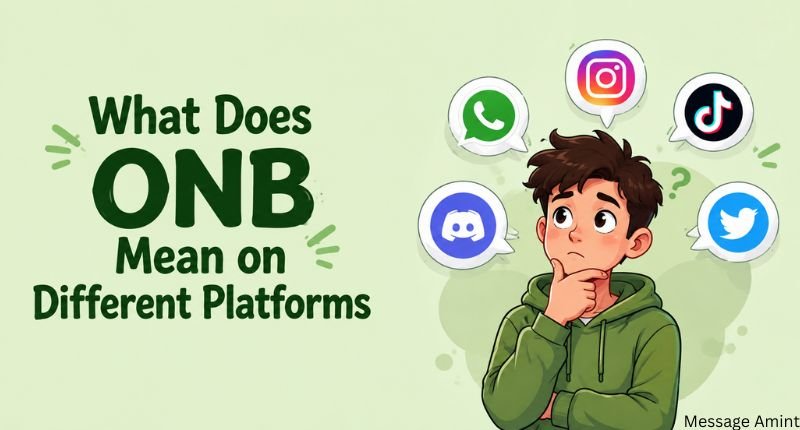
Slang doesn’t behave the same way everywhere. A word that means one thing in a DM can carry a slightly different weight in a comment section.
- Instagram: shows up in comments or DMs reacting to something impressive — “onb that’s crazy” means the person genuinely means it
- TikTok: attached to relatable videos — “onb I felt that” emphasizes how accurate the clip felt
- Snapchat: used in quick, personal exchanges — “yeah, onb I can’t sleep” adds a stamp of sincerity
- WhatsApp: tends to feel more personal, since most threads are one-on-one or small family groups
- From a girl: the meaning doesn’t change by gender — it still means “I’m being genuine,” though it can carry more emotional weight in a personal message like “I miss you, onb”
Context always matters more than the platform. A group chat might use it as a punchline, while a one-on-one message turns it into real reassurance.
Read More: FG Meaning in Text
Other Meanings of ONB (Non-Slang)
Not every search for this term is about slang. ONB is also a legitimate abbreviation in a few unrelated fields.
- Banking: ONB commonly refers to Oriental Bank of Commerce, a name used in Indian banking before it merged into Punjab National Bank in 2020
- Medical: ONB can stand for olfactory neuroblastoma, a rare tumor that forms in the nasal cavity
- Job/Work context: ONB is sometimes shorthand for “onboarding” in HR systems and internal scheduling notes, referring to how a new employee gets set up
If you see “ONB” in a bank statement, a medical chart, or an HR email, it almost certainly isn’t the slang meaning — the surrounding context will make that clear right away.
Common Typos & Similar Terms
Text slang gets mistyped constantly, especially on a phone keyboard where letters sit close together.
- OMB: usually a typo for “oh my bad,” or short for “oh my,” used like “omg”
- OHB: less common, generally stands in for “oh baby,” or is simply a typo of “onb” since the letters sit next to each other
Neither of these carries its own established slang meaning the way onb does. If a message looks strange but the rest of the sentence reads clearly, it’s usually a typo rather than a brand-new piece of online slang.
Origin & Background
Understanding where a word comes from usually explains why it works the way it does today.
Where It Came From
Onb didn’t start online. It grew out of spoken slang in urban communities, particularly hip-hop and street culture, where swearing “on” something — your family, your faith, your word — has been a way to add weight to a statement for decades. Texting culture picked up an already-existing habit of speech and shortened it.
Cultural Influence
Rap lyrics played a real role in spreading this pattern. Artists would say “on god” or “on my mama” to stress a line wasn’t exaggerated, and fans carried that phrasing into everyday conversation. “On buddha” became a lighter alternative to “on god” for people who didn’t want to reference religion directly, and onb followed the same path as its own shorthand.
Social Media Impact
Once TikTok and Instagram comment sections became a daily habit for millions of people, short, punchy slang had room to spread fast. A word doesn’t need a dictionary entry to catch on. It just needs enough people repeating it until it feels normal.
How Meaning Evolved
- Early use: carried real weight, almost like staking your credibility on it
- Now: works in both jokes and serious statements
- Reader’s job: pick up the tone from context, not just the word itself
Internet language rarely stays still for long. Texting shorthand works the same way, borrowing from wherever it’s convenient and reshaping itself for whatever app people are using that year.
Real-Life Conversations
Seeing the word in action explains it faster than any definition alone.
WhatsApp Person A: Did you actually cook this yourself? Person B: Onb, no help at all.
Instagram DM Person A: Your photos from the trip are unreal. Person B: Onb, that view in real life was even better.
TikTok Comments User1: This is exactly how my mornings go 😭 User2: Onb, felt this in my soul.
Text Message Friend A: You’re not backing out this time, right? Friend B: Onb, I’ll be there by 6.
Group Chat Person A: Who ate the last slice of pizza? Person B: Wasn’t me, onb. Person C: Suspicious, but okay.
Notice how the word slots in wherever it’s needed, before or after the main point, without changing the rest of the sentence.
Read Also: NTP Meaning in Text
Emotional & Psychological Meaning
What onb actually communicates, in short:
- Emotion it expresses: sincerity — “I’m not exaggerating right now”
- Why people use it: it compresses “I promise I’m being honest” into three letters
- What it reveals: modern texting rewards speed over full sentences, so slang carries the meaning instead
- Social layer: using the same word as your friends signals you’re part of the same conversation
A quick example: a friend hears a rumor about themselves. Instead of a long defense, they text one line — “Onb, none of that happened.” The shortness itself signals confidence.
This is really what Gen Z slang is built around — less about the words, more about showing you’re plugged into the same conversation as everyone else in the chat.
Usage in Different Contexts
- Social media: appears in comments reacting to something relatable or surprising, usually paired with an emoji
- Friends & relationships: works as a small trust marker — “I mean this, don’t read it as a joke”
- Work / professional settings: has no place in emails or client messages — too casual, reads as unprofessional
- Casual vs serious tone: a laughing emoji signals a joke; a period or nothing at all means the person wants it taken at face value
When NOT to Use It
- Inappropriate contexts: job applications, school essays, official emails, customer service chats
- Cultural sensitivity: older readers or people outside youth-heavy online spaces may not recognize the word at all
- Situations causing misunderstanding: serious discussions, negotiations, or formal group chats, where it can read as dismissive
A safe rule: if you’d hesitate to say “I swear” out loud in that setting, skip the slang version too.
Common Misunderstandings
- What people get wrong: assuming it’s a random keyboard mash instead of an actual slang term
- Tone confusion: the emoji or punctuation around it can shift the reading from sincere to sarcastic
- Literal vs figurative meaning: nobody is literally swearing on a person or object — it’s a figure of speech, the same way “I’d die for this pizza” isn’t literal either
Comparison Table
Onb sits next to several other sincerity markers that mean roughly the same thing.
| Expression | Meaning | Tone | Usage |
| Onb | On bro / on blood / on Buddha | Sincere emphasis | Casual slang |
| Ong | On God | Strong sincerity | Casual slang |
| No cap | No lie | Emphasis | Youth slang |
| FR | For real | Agreement | Very casual |
| I swear | Strong truth claim | Neutral to serious | Formal and informal |
Key Insight
Onb sits inside a family of words built around one idea: swearing something is true without literally swearing on anything.
How ONB Compares to Everyday Words
| Expression | Meaning | Use Case | Tone |
| Onb vs okay | Sincerity claim vs simple approval | Onb backs up a statement; okay just agrees | Onb is emotional, okay is flat |
| Onb vs got it | Sincerity claim vs confirmation of understanding | Onb proves honesty; got it confirms a task was heard | Onb is casual, got it is neutral |
| Onb vs noted | Sincerity claim vs formal acknowledgment | Onb fits friends; noted fits work chats | Onb is warm, noted is professional |
| Onb vs bet | Sincerity claim vs agreement to a plan | Onb defends truth; bet confirms a plan is on | Both casual, but bet doesn’t imply sincerity |
Onb isn’t really competing with words like “okay” or “noted.” Those are acknowledgment words. Onb stands behind a statement instead of simply responding to one.
Variations / Types of ONB
- ONB (On Baby): softer, affectionate version — used between partners or close friends
- ONB (On Bro): the most common everyday version, used casually between friends
- ONB (On Blood): stronger and more intense, tied to street slang, used when someone really wants to stress a point
- ONB (On Buddha): a lighter substitute for “on God” — one of the most recognized forms, even though it’s rarely explained
- ONB fr: combines with “for real” to double down on sincerity
- ONB tho: adds a slight contrast, often used when a statement sounds surprising
- ONB ngl: pairs with “not gonna lie,” stacking two honesty markers
- ONB fr fr: repeated for extra emphasis
- ONB I swear: mixes slang with plain English
- ONB deadass: combines two intensity markers, used in dramatic or urgent messages
- ONB no cap: stacks two slang phrases together for maximum emphasis
Most variations follow the same pattern: take the base word, attach another slang term, and the sentence gets louder without getting longer in meaning.
How to Respond When Someone Uses It
- Casual: “Alright, I believe you.” / “Okay okay, noted.”
- Funny: “That better actually be true 😂” / “Put it in writing then.”
- Mature: “Got it, thanks for being upfront.” / “Appreciate you telling me straight.”
- Respectful: “I hear you, thank you.” / “Understood, thanks for explaining.”
Regional & Cultural Usage
- Western culture: most common in the US and UK, tied to hip-hop and street culture where the phrase took shape
- Asian culture: mostly seen among English-speaking youth on Western-influenced platforms like TikTok and Instagram
- Middle Eastern culture: less widespread, but appears in gaming chats and social media comments
- Global internet usage: short-form video platforms carried it well beyond any single country
- Generational differences: Gen Z uses it naturally, Millennials lean toward “fr” or “I swear,” older generations often don’t recognize it at all
Explore More: Funny Responses to “Are You Busy?”
Is It Safe for Kids?
On its own, onb isn’t offensive or harmful. It did grow out of slang that sometimes appears alongside more mature or explicit language in its original context, so:
- Safe in casual, everyday texting
- Not appropriate for schoolwork or formal writing
- Worth a quick explanation from a parent if a child starts using it heavily
FAQs
What does ONB stand for?
It usually stands for “on bro,” “on blood,” or “on Buddha,” used to emphasize that something is true.
Is ONB slang or formal language?
It’s entirely informal slang, meant for texting and social media.
Is ONB a bad word / offensive?
No, it isn’t offensive on its own, though it came from slang that can appear in more intense conversations. If you’re wondering is onb offensive enough to avoid, the honest answer is no — just read the room before using it around people you don’t know well.
Can I use ONB at work or in school writing?
No. It’s too casual for professional emails, academic work, or any formal setting.
Is ONB the same as “ok” / does it mean the same everywhere?
Not quite. “Ok” is neutral acknowledgment; onb is closer to “I swear.” The core meaning stays consistent across groups, even if the exact feel shifts slightly.
How do I respond to ONB?
A simple “got it” or “I believe you” works fine, or match the tone with something more playful.
Is ONB used on TikTok?
Yes, especially in comment sections reacting to something relatable.
Can ONB be used globally?
Yes. Thanks to social media, it’s understood by young, internet-active audiences in many countries, though usage is heaviest in the US and UK.
What is the safest meaning of ONB?
“On bro” is the most neutral, widely understood version if you’re not sure which variant someone means.
Conclusion
Onb isn’t complicated once you see it for what it is: a quick, informal way of saying “I mean this.” It grew out of spoken slang, moved through hip-hop culture, and found a permanent home in texting and comment sections, where speed matters more than spelling things out.
Knowing the different variations, from “on bro” to “on Buddha,” helps you read tone correctly instead of guessing. And now that you know what onb means, you’ll never have to pause mid-scroll wondering what someone actually meant by it.
New popular internet abbreviations will keep replacing old ones, and common Gen Z abbreviations will keep shifting from one platform to the next. Understanding texting slang meanings and digital slang terms like onb simply makes it easier to keep up with wherever that conversation goes next.
Iqra Mubeen is the Founder of Message Amint, with 3+ years of experience in SEO, content writing, and guest posting. She specializes in creating engaging, easy-to-share content around everyday communication — from heartfelt messages to relationship wishes. Her work focuses on helping readers express their feelings in the simplest, most meaningful way.